
November 10, 2026

LED TVs have become an essential part of modern homes. They provide clear picture quality, excellent colors, and entertainment for the entire family. However,...


Choosing the right air conditioner can make a big difference to your electricity bill, especially during Pakistan’s hot summer months. With rising electricity costs and long hours of AC usage, many homeowners are comparing inverter and non-inverter air conditioners to find the more economical option.
But which one actually saves more electricity? In most cases, an inverter AC is more energy-efficient, particularly when it runs for several hours a day. However, the best choice depends on your room size, usage habits, budget, and cooling requirements.
In this guide, we will explain the difference between inverter and non-inverter Ac, compare their electricity consumption, and help you decide which option is best for your home in Pakistan.
An inverter AC uses advanced technology to adjust the speed of its compressor according to the room’s cooling needs. Instead of repeatedly switching the compressor on and off, it can slow down or speed up to maintain a comfortable temperature.
For example, when you turn on an inverter AC in a hot room, the compressor may work harder initially to cool the space. Once the room reaches the desired temperature, it reduces its output and continues running at a lower level.
An inverter AC is often a practical choice for bedrooms, family lounges, and other spaces where the air conditioner runs for several hours daily.
A non-inverter AC generally operates its compressor at a fixed speed. When the room becomes warmer than the selected temperature, the compressor switches on. Once the room cools sufficiently, the compressor switches off and starts again when cooling is needed.
This repeated starting and stopping can consume more electricity in some operating conditions, particularly when the AC is used for extended periods.
A non-inverter AC may suit people with a limited upfront budget or those who only need cooling occasionally.
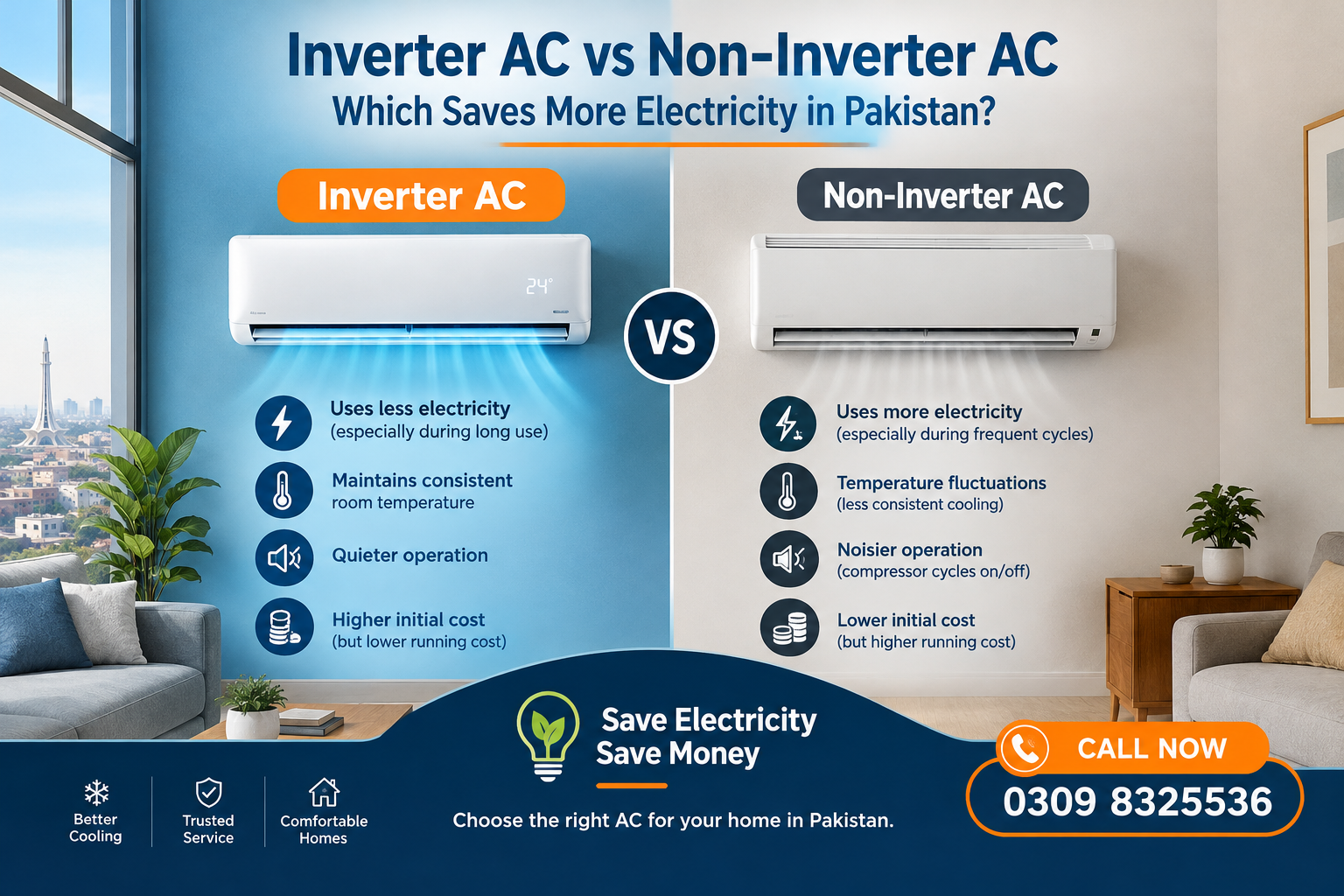
| Feature | Inverter AC | Non-Inverter AC |
|---|---|---|
| Compressor operation | Adjusts speed as needed | Usually runs at a fixed speed |
| Electricity use | Often lower during extended use | Can be higher during extended use |
| Room temperature | More consistent | More noticeable temperature changes |
| Purchase price | Usually higher | Usually lower |
| Noise | Often quieter | Compressor cycling may be more noticeable |
| Best suited for | Frequent or daily use | Occasional or shorter use |
| Long-term running costs | Often lower | May be higher |
Actual performance varies by model, cooling capacity, energy efficiency, room conditions, and usage habits.
For many households, an inverter AC is the better option for reducing electricity consumption. Its main advantage is that it can lower compressor speed after reaching the desired temperature instead of repeatedly switching between full operation and complete shutdown.
This is especially useful in cities such as Karachi, Lahore, Islamabad, and Multan, where air conditioners may run for long periods during hot weather.
However, an inverter AC does not guarantee a specific percentage of savings. The actual difference depends on the models being compared and how they are used.
If you run your AC for six to ten hours daily, an inverter model may offer meaningful electricity savings over time.
For example, a family using an AC throughout the night may benefit from the inverter compressor adjusting its output as the room cools.
If you switch on an AC for only 30–60 minutes at a time, the financial benefit of choosing an inverter model may be smaller. In this situation, the purchase price and the efficiency of the specific models become important factors.
During Pakistan’s summer, an AC may need to work harder because of high outdoor temperatures, direct sunlight, and poor room insulation. An appropriately sized inverter AC can adjust its operation to meet changing cooling demands.
However, extreme heat can still increase electricity consumption. Inverter technology cannot eliminate the effect of harsh weather or an inefficient room.
Electricity consumption depends on the AC’s capacity, efficiency rating, outdoor temperature, room size, and compressor workload.
For a simple estimate, consider two hypothetical Ac with different average power consumption. These figures are examples for calculation only, not guaranteed consumption figures for actual products.
Estimated daily electricity use:
In this example, the inverter AC uses 3.2 fewer units per day.
Over 30 days, that would equal 96 fewer units. To estimate the cost difference, multiply the units saved by your applicable electricity rate.
These figures illustrate the calculation method only. Actual consumption can be lower or higher, and a real comparison requires the specifications or measured power consumption of the two AC models.
The right choice depends on your room and daily routine.
Before purchasing, compare the energy labels and efficiency specifications of individual models rather than assuming that every inverter AC is more efficient than every non-inverter AC.
Whether you choose an inverter or non-inverter model, good usage habits can help reduce energy consumption.
Try setting the AC around 24–26°C if that feels comfortable for your household. Setting a much lower temperature generally increases the cooling workload.
An undersized AC may struggle to cool the room, while an oversize unit may not operate efficiently under every condition. Consider room dimensions, ceiling height, sunlight, insulation, and the number of occupants.
Dirty filters restrict airflow and can make cooling less effective. Check and clean your filters according to the manufacturer’s instructions.
Hot air entering the room makes the AC work harder. Close gaps where practical and use curtains or blinds to reduce direct sunlight.
Clean coils, proper airflow, correct refrigerant levels, and healthy electrical components all contribute to efficient operation. Arrange professional servicing when needed.
Check the product’s energy label, rated power input, efficiency rating, and warranty. A highly efficient model with the right capacity may be a better investment than a cheaper unit with higher running costs.
An inverter AC can be worth the extra purchase price if you use it frequently and plan to keep it for several years. Electricity savings accumulate over time, potentially helping you recover some or all of the difference in upfront cost.
To compare two models, calculate the estimated monthly running cost of each one using realistic consumption figures and your electricity rate. Then compare the expected savings with the difference in purchase price.
Remember that the final bill also depends on other household appliances, applicable electricity tariffs, taxes, and billing adjustments.
For most Pakistani households that use air conditioning for several hours a day, an inverter AC is generally the better choice for electricity savings. Its variable-speed compressor can reduce power consumption after the room reaches the desired temperature while maintaining more consistent cooling.
A non-inverter AC can still be suitable for occasional use or when the initial purchase budget is the main concern. Before deciding, compare individual models, choose the correct capacity, and consider how many hours you will use the AC each day.
The smartest choice is not simply the AC with the lowest price. It is the model that delivers reliable cooling, appropriate energy efficiency, and good value over its working life.
An inverter AC often consumes less electricity when used for several hours daily. Actual savings depend on the model’s efficiency, room conditions, temperature settings, and operating hours.
It can reduce electricity costs compared with a less efficient non-inverter model, especially during extended use. The amount saved varies, so compare the actual energy specifications before buying.
It can be, particularly if the AC is used occasionally and the purchase budget is limited. However, a correctly sized, efficient inverter model may still be more economical if you use it regularly.
A setting around 24–26°C is a reasonable starting point for many homes. Adjust it to your comfort, keep filters clean, and reduce heat entering the room to help control electricity consumption.
LED TVs have become an essential part of modern homes. They provide clear picture quality, excellent colors, and entertainment for the entire family. However,...

A water dispenser is an essential appliance in many Pakistani homes and offices. It provides cold and room-temperature water whenever needed, especially during Karachi’s...

A microwave oven is one of the most useful kitchen appliances in modern homes. It makes cooking, reheating food, and preparing meals quick and...